Categories

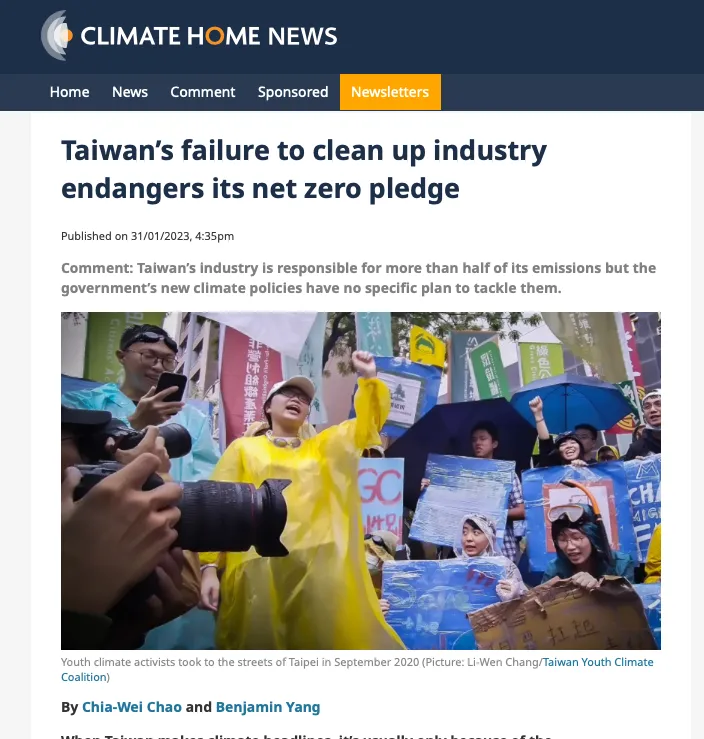
(Climate Home News)No Carbon Budget left for Incremental Progress in Taiwan’s Climate Policy

  • Chia-Wei Chao(Research Director)、Pei-Wei Yang(Researcher)

We published a commentary about the 12 key net-zero strategies and the climate change response act on Climate Home News. Due to considerations of reader friendliness and words limitation, the final version of the commentary is quite condensed compared than the original draft. Hence is the complete version:

Chia-Wei Chao and Pei-Wei Yang, Taiwan Climate Action Network

Taiwan has become an issue of interest in the global climate regime lately due to the geopolitical effects of the US-China climate dialogue. The island itself, however, ranks 22nd globally in terms of territorial CO2 emissions and is among the top five most exposed countries to climate risks — the progress of Taiwan’s climate policies therefore cannot be viewed as a mere footnote to the US-China competition, but an issue that merits great scrutiny on its own.

Recently, there are two defining moments in Taiwan climate policy: the announcement of the government’s 12 Key Strategies Action Plan of Net-zero Transitions (hereafter ’12 Key Strategies’) and the passing of the Climate Change Response Act in the Legislative Yuan (Parliament).

First, the details of the 12 Key Strategies announced last December 28th laid out the budget allocation of $900 billion NTD ($30 billion USD) in climate investments up till 2030, as well as some key milestones in that timeframe. These include tripling the installed capacity of renewable energy, initiating hydrogen and CCUS development, accelerating the improvement of energy and material efficiency, and mobilizing lifestyle change and just transitions.

The Climate Change Response Act, on the other hand, was passed on January 10th this year. As a series of major amendments to the existing 2015 Greenhouse Gas Management Act, the Climate Act has made Taiwan the 18th country to have a legally binding net-zero target. In addition to a more stringent long-term target, the Act also authorizes the implementation of carbon levy, enhances the institutional capacity of adaptation, and establishes the governance structure and budgetary support for just transition. However, these progress are still insufficient to ensure Taiwan’s eventual fulfillment of its climate pledges due to the following key shortcomings.

Perhaps the most notable shortcoming in the 12 Key Strategies is the absence of a coherent action plan on industrial decarbonization. The industrial sector contributes to over 50% of Taiwan’s carbon emissions, yet there is no specific strategy dedicated to industrial decarbonization among the 12 Key Strategies. Instead, mitigation measures related to harder-to-abate sectors are scattered across the hydrogen development, energy conservation, CCUS, resource circulation and zero waste Key Strategy Action Plans, without a coherent approach to deploying policy instruments and creating enabling conditions. Furthermore, the huge climate investment isn’t guided by mission-oriented principles. This unprecedented $900 billion NTD climate investment should focus on accelerating the market readiness of hydrogen, CCUS and long-duration storage etc. But the Action Plan only allocated a $4.6 billion NTD budget for hydrogen and $3.7 billion NTD for CCUS, which is less than 1% of the total climate investment and remains inadequate in spurring demand and creating cost-competitiveness.

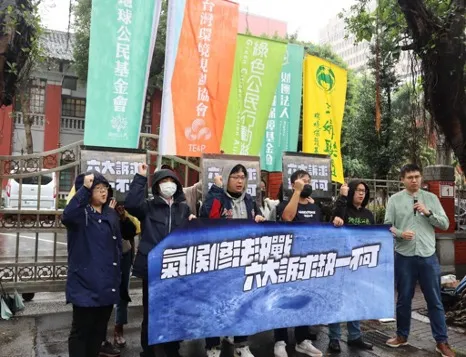
As for the Climate Change Response Act, the years-long campaign of local climate advocates has led to significant gains, such as tightening the criteria for offset programs and limiting the proportion of revenues allocated back to large emitters in the carbon levy design, as well as strengthening the overall climate governance structure by expressly stipulating the responsibilities of each ministry and local governments. But there remain three key hurdles that we couldn’t break. First, an independent advisory body like the Climate Change Committee in the UK failed to be established due to the restrictions of bureaucratic organizational structure. Second, the external cost of emission is only partially internalized through the carbon levy, as the fossil fuel subsidies reform was deleted from the final text due to recent instability in energy prices, while broader fiscal and tax reforms were blocked by the Ministry of Finance. Lastly, climate litigation, which can be a helpful means to hold the government and corporations accountable, was rejected because of the judicial and administrative systems’ unfamiliarity with such types of litigation.
The experience of these historically significant but ultimately insufficient progress in Taiwan also hold several important takeaways for global climate policy. Although the upcoming EU CBAM and discussions around global carbon price have softened the traditional opposition from energy-intensive industries to carbon pricing, attempts to avoid the impacts of mitigation efforts by lobbying for low levy rates, loose offset rules and subsidies via carbon levy revenues persist. Such tactics can be countered through a global stocktake process that reviews the content of carbon price schemes of different countries and jurisdictions to highlight best practices. Moreover, during the parliament’s deliberations on the Climate Change Response Act, most legislators remain unfamiliar with several important concepts such as the ratchet mechanism of the Paris Agreement or how the national adaptation plan works, which caused unnecessary delays and impracticable proposals. Hence, regular training courses that build up climate literacy of parliamentary staff is crucial to passing a high-quality climate change law. Finally, while G7 tries to accelerate the decarbonization of industrial sectors through the Climate Club, industrial decarbonization knowledge networks are still comparatively narrower than those of renewable energy or mobility electrification. Policy mechanisms such as carbon contracts for difference and purchase commitments are hence key for manufacturing hubs like Taiwan in enabling industries’ transitions to climate-friendly technologies.

Original source: Link

Related Posts

Categories

(Taiwan Insight)With its threats to withdraw from the Paris Climate Agreement and its “energy dominance” agenda, the return of the Trump administration is set to disrupt the global energy landscape. This marks a sharp contrast to the climate legacy of the Biden administration, characterised by historic investments, governance innovation, and renewed international leadership. The Biden administration has implemented a comprehensive approach to address climate change through legislation, policy coordination, and international leadership. The Inflation Reduction Act (IRA), passed in 2022, allocates $370 billion in federal incentives, the largest climate-focused investment globally. The IRA mandates that 40% of the funds benefit disadvantaged communities and enforces strict environmental standards for hydrogen projects. To ensure effective implementation, the Biden administration established the National Climate Task Force, adopting a whole-of-government approach to domestic climate policy coordination. Therefore, climate change is listed as a key pillar of the National Security Strategy and Trade Policy Agenda. The Department of Treasury, for example, proposed the first Climate Action Plan in 2021. In addition to the federal level, the local climate actions were also strengthened by providing grants to support each state, Metropolitan Statistical Area, Tribe, and territories to develop priority climate plans. Internationally, Biden restored US leadership in climate negotiations, convening the Leaders’ Summit on Climate in 2021 and fostering global initiatives such as the Global Methane Pledge and the Green Shipping Challenge. Collaborations like the First Movers Coalition also mobilised private-sector support for green technologies like steel and concrete. Within the formal UN COP process, the US also played a constructive role in formalising the “loss and damage fund” and “transition away from fossil fuel” in the negotiation texts. This progress made in addressing climate change, however, faces significant challenges as Trump prepares to take office in January. The Heritage Foundation’s Project 2025, a comprehensive 900-page policy blueprint for the next Republican administration, recommends scaling back environmental regulations, expediting fossil fuel project permits, and halting clean energy subsidies. According to Energy Innovation, implementing Project 2025 could increase US greenhouse gas emissions by 27% by 2030, adding 0.04°C of warming by 2100. Trump’s appointees for key climate and energy positions signal a dramatic policy shift. Former North Dakota Governor Doug Burgum is nominated to lead the Interior Department and chair the newly established National Energy Council, tasked with dismantling the achievements of the National Climate Task Force. Chris Wright, CEO of Liberty Energy, is poised to become Secretary of Energy, while former Congressman Lee Zeldin is tapped to lead the Environmental Protection Agency (EPA). Zeldin, an outspoken advocate for energy dominance, emphasised the importance of gasoline vehicles during his nomination announcement. Domestically, Trump has pledged to halve energy and electricity prices within 18 months, aiming to achieve this by ramping up fossil fuel production on federal lands and removing utility regulations. However, experts warn that these goals are unrealistic, given the interconnected nature of global oil markets. Internationally, Trump plans to withdraw the US from the Paris Climate Agreement once again, potentially by 2026. This retreat would weaken global climate cooperation, particularly by reducing the US’s $11 billion climate finance commitment, limiting other countries’ ability to propose ambitious climate plans necessary for closing the emissions gap. For Taiwan, climate change and energy transition have played a growing role in its partnership with the US over the past four years. The American Institute in Taiwan (AIT) has supported climate expos and forums, while the 2024 Global Cooperation and Training Framework (GCTF) focused on the net-zero transition. Moreover, the U.S.-Taiwan Initiative on 21st-Century Trade includes a dedicated chapter on environmental and climate issues. Another symbolic climate moment was when President Tsai announced Taiwan should commit to Net-Zero by 2050 at a forum supported by AIT. However, starting in 2025, climate change may no longer serve as a shared priority between the US and Taiwan, creating new challenges for Taiwan’s international climate engagement. To adapt to this shifting landscape, Taiwan must conduct a strategic analysis to mitigate risks and capitalise on emerging opportunities. One key issue for analysis is the geopolitical impact of climate change. Over the past four years, U.S.-China cooperation has been crucial for advancing global climate negotiations. If the US steps back, the EU and UK may collaborate with China to stabilise the global climate regime. However, China has previously used climate negotiations as leverage in geopolitical disputes, such as suspending climate talks with the US following Nancy Pelosi’s visit to Taiwan. Taiwan must account for these risks when engaging with EU and UK leadership. Another critical issue is Taiwan’s energy relationship with the US. Currently, the US supplies 10% of Taiwan’s liquefied natural gas (LNG). While the Biden administration temporarily paused LNG terminal expansions in early 2023, the Trump administration is likely to promote increased LNG exports. This raises concerns about the “lock-in effect,” where expanded LNG infrastructure could hinder decarbonisation efforts after 2035. To address this, Taiwan should establish a clear roadmap for LNG use that balances energy security with long-term climate goals. In terms of trade, electric vehicles (EVs) and battery storage have been focal points of U.S.-Taiwan cooperation under Biden. While “energy transition” prioritises shifting away from fossil fuels toward renewable energy sources to achieve decarbonisation, “energy innovation” emphasises advancing technologies to enhance energy production and efficiency, regardless of the energy source. Under Trump, “energy transition” may lose prominence at the federal level, but “energy innovation” will likely remain a priority of their energy dominance agenda. Advanced geothermal energy, for instance, could attract significant investment. Taiwan has recently announced an ambitious target of over 3 GW of geothermal energy by 2030. By expanding its geothermal strategy, Taiwan could strengthen energy trade with the US, balancing economic ties while advancing decarbonisation goals. In conclusion, Trump’s return to the presidency could reshape the global energy landscape, challenging Taiwan to navigate a more uncertain climate policy environment. By proactively addressing geopolitical risks, energy flows, and trade opportunities, Taiwan can safeguard its climate ambitions while maintaining robust ties with the US. Dr Chia-wei Chao is the Research Director of Taiwan Climate Action Network (TCAN) and an Adjunct Assistant Professor at National Taiwan University’s Program in Climate Change and Sustainable Development.